

Tablet manufacturing services
Formulation, quality and production from a single source
Tablets are a highly versatile dosage form in the dietary supplements sector. Whether they contain vitamins, minerals or selected plant-based substances – which ingredients are suitable and how a stable, easily dosed tablet can be produced from them depends on several factors.
As a contract manufacturer of dietary supplements, Biohealth supports you and your brand in the development and production of bespoke tablet formulations. We precisely coordinate raw materials, excipients, tablet format and production parameters. The result is tablets, ‘Made in Germany’, that are precisely tailored to the requirements of your target audience.
Would you like to have tablets manufactured? Find out what matters when it comes to formulation, quality and industrial tablet production.

An overview of tablet formats
The appropriate shape and size of a tablet depend on several factors: the required amount of active ingredient, the properties of the formulation, the intended method of administration and the handling requirements.
At Biohealth, you can choose from a range of different tablet formats. These include round and oblong shapes in various sizes. We tailor the specific formats available on a case-by-case basis during the product planning stage, taking the relevant requirements into account. This is because the choice of tablet format should always be made with the formulation in mind. Whilst a larger tablet offers more space for the formulation, it is not automatically the best solution for the target group or the intended use.

Which type of tablet is right for the product you’re looking for?
As well as the formulation and format, the desired experience when taking the medicine is the key factor in determining the most suitable type of tablet. We’d be more than happy to advise you on this. This is because different types of tablet have different requirements in terms of strength, disintegration, taste and mouthfeel.
Oral tablets are taken with liquid. The key considerations here are sufficient hardness, a stable shape and reliable dosing.
Depending on the formulation – as with other types of tablets – microcrystalline cellulose, calcium carbonate, starch and other excipients can fulfil appropriate technological functions. The most suitable combination depends on the active ingredients used and the desired properties.
Chewable tablets are chewed before being swallowed. This is why taste, texture and mouthfeel are particularly important. The tablet should not be unnecessarily hard and should be pleasant to chew.
Suitable ingredients for the formulation include, for example, isomalt, sorbitol or maltodextrin, as well as appropriate flavourings. The choice depends on the desired sweetness, texture, technological requirements and the active ingredients around which the tablet matrix is built. Mannitol is also a suitable pharmaceutical excipient, as it delivers good sensory results and is ideally suited to direct compression.
Lozenges dissolve gradually in the mouth whilst being taken. The sensory experience is therefore particularly important. The flavour, flavour profile and the speed at which the lozenge dissolves must all be carefully balanced.
As with chewable tablets, ingredients such as isomalt, sorbitol, maltodextrin, xylitol and flavourings can be used. The specific composition depends on the product concept in question.
Dispersible tablets are dispersed in a liquid. Unlike a fully dissolved tablet, not all of the constituents need to be dissolved at a molecular level. Dispersible tablets are suitable, amongst other things, for older people, who may, for example, have difficulty swallowing and require a high fluid intake.
Key factors include dispersibility, the properties of the particles used and the desired user experience. Suitability depends on the composition and the requirements for the finished product.
The following factors are particularly crucial:
- The active ingredients and excipients must be technologically compatible.
- The ingredients should be evenly distributed throughout the tablets.
- The tablet must be able to withstand mechanical stress.
- Its disintegration behaviour must be suitable for the intended use.
- The surface should shed as few particles as possible.
- Taste, smell and mouthfeel must be consistent with the overall tablet concept.
These properties cannot be optimised independently of one another. For example, a higher compression force may increase hardness, but at the same time affect disintegration. It therefore always depends on the individual interplay between the formulation, the properties of the raw materials and the manufacturing process.
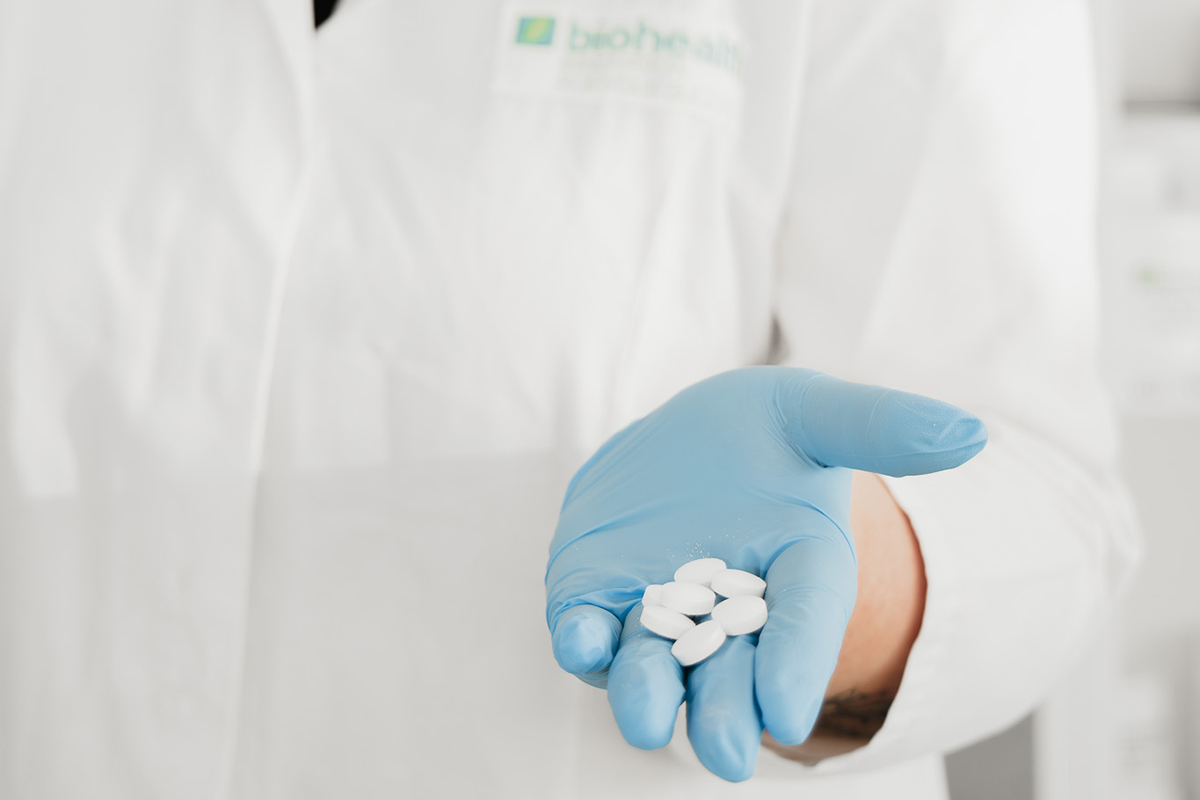
What active ingredients should your tablet contain?
The choice of active ingredients depends on your product concept and the desired product properties. For food supplements, for example, the following groups of substances may be considered:
- Vitamins
- Minerals and trace elements
- Amino acids
- Plant substances and plant extracts
- Other nutritionally relevant substances
However, not every raw material can be processed into a tablet with the same degree of success. Particle size, flowability, moisture content, density and compressibility all influence how well a raw material can be integrated into a formulation.
What is the function of excipients?
Excipients perform technologically important tasks in tablet manufacture. Among other things, they help to ensure that the powder mixture is processed uniformly, that the tablet achieves the required strength, and that the manufacturing process can be controlled in a reproducible manner. Furthermore, they play an important role in sensory properties – that is, the experience of taking a tablet. For example, they can influence the taste and the sensation of warmth in the mouth when the tablet is taken.
Depending on the formulation, different groups of substances are used:
Fillers help to control the weight of the tablets and the required volume. Examples include starch and lactose.
Binders help the particles to stick together, thereby facilitating the formation of a stable tablet. Examples include microcrystalline cellulose (MCC) and calcium hydrogen phosphate, although their specific function depends on the formulation.
Disintegrants help a tablet to disintegrate on contact with liquid. Examples include starch, croscarmellose and – depending on the formulation – glucomannan.
Lubricants reduce friction during tableting and can minimise the powder mixture sticking to the tablet press components. Furthermore, they also improve the lubrication between the particles themselves, enabling them to flow more freely. A commonly used example is magnesium stearate.
Flow aids help to ensure that the powder mixture flows evenly. Silica, for example, can help to improve the processing of powdered raw materials.
Excipients in tablets
Myths and Facts
In public debates, many people often take a critical view of processing aids. However, their technological functions and their health assessment are not always clearly distinguished from one another.
A nuanced approach is crucial for product development: What function does a substance fulfil? What are its specifications? Is it authorised for the intended use and suitable for the specific formulation?
❌ “Magnesium stearate is bad for the immune system.”
✅ Magnesium stearate is primarily used as a lubricant in tablet manufacture. It can reduce friction between the tablet and the mould, thereby facilitating the production process.
The blanket assertion that magnesium stearate is inherently harmful to the immune system is not sufficiently supported by scientific evidence. As with other food additives and processing aids, the specific use, intake and applicable safety assessments must be taken into account.
❌ “Tablets can be manufactured without excipients.”
✅ In principle, this is possible in certain cases, but not with every formulation. In complex mixtures in particular, particle size, shape and flow behaviour vary. Without suitable excipients, it can then be more difficult to produce a sufficiently stable tablet, ensure a uniform powder feed or prevent the mixture from sticking to machine parts.
The key is not to avoid excipients across the board, but to develop a functional formulation tailored to specific needs. The choice of substances used should be guided by the technical requirements, the applicable regulations and the desired product profile.
Hardness, or breaking strength, describes the amount of mechanical stress a tablet can withstand before it breaks. It is relevant for transport, packaging and handling, amongst other things.
If a tablet is too soft, it is more likely to break or become damaged. Conversely, an excessively hard tablet may – depending on its formulation and format – disintegrate more slowly. The appropriate hardness must therefore be determined for each specific product.
Disintegration describes how a tablet breaks down into smaller components under defined test conditions. The desired behaviour depends on the intended use.
The requirements for a tablet intended to be swallowed differ from those for a lozenge or a dissolving tablet. Disintegration and complete solubility are not the same thing: a disintegrated tablet does not necessarily dissolve completely in liquid.
Abrasion describes the extent to which a tablet loses particles as a result of mechanical stress. High abrasion can lead to damaged surfaces, dust formation or visual defects.
A suitable abrasion value is therefore important for the handling and packaging of the tablets. How the test is carried out and which limit values apply depends on the product-specific requirements.
Sensory evaluation takes into account, amongst other things, taste, smell, surface texture and mouthfeel. Sensory properties play a key role, particularly in the case of chewable and lozenges.
A suitable sensory profile is created through the interplay of active ingredients, excipients, flavourings and tablet structure. Not every raw material can be integrated equally well in terms of taste or texture.
The quality parameters must be considered as a whole. A tablet is considered well-designed if its properties match the product concept and it can be manufactured reproducibly within the defined requirements.
Which production parameters affect
tablet quality?
When companies commission the manufacture of tablets, it is worth taking a look at the key variables in the process in order to better understand its complexity. After all, a well-developed formulation is not enough; it must be possible to process it reliably on the tablet press.
Alongside the choice of raw materials, compression force is one of the key factors influencing the hardness of a tablet. It determines how firmly the powder mixture is compacted during tableting.
Insufficient compression force can lead to inadequate strength. A higher compression force can increase hardness, but also affects disintegration and other properties. The appropriate range must therefore be determined based on the formulation and tablet format.
A higher production speed does not automatically mean a better process. Depending on the raw materials and the plant configuration, it can reduce the time available for compaction and increase the risk of tablet defects.
The speed must therefore be selected in such a way that productivity and reproducible tablet quality are compatible.
A consistent feed of powder into the dies – that is, the moulds into which the powder is compressed – is important, as fluctuations can lead to variations in tablet weight and, consequently, to deviations in other quality parameters.
How well a powder mixture can be fed depends, amongst other things, on its flowability, particle structure and composition.
In external lubrication, a lubricant is applied specifically to the mould surfaces, rather than being incorporated solely into the powder mixture. Depending on the process, this can help to reduce friction and sticking, thereby preventing certain tablet defects.
One potential advantage is that, as the lubricant is not incorporated directly into the formulation in this process, it does not necessarily have to be declared as an ingredient on the list of ingredients.
Whether external lubrication is appropriate depends on the formulation, the process and the equipment used.
The tablet size and the position of the dies also influence the conditions during tableting. The diameter, shape and geometry help to determine how the powder mixture is compacted and how the finished tablet is ejected from the die.
The settings must therefore be tailored to the formulation and the desired format. Successful tablet production results from the interplay of these parameters – not from optimising a single variable.
Having tablets manufactured by Biohealth
Tablets ‘Made in Germany’
Anyone wishing to have tablets manufactured in Germany is not just looking for a production facility, but for a reliable partner to help bring their own product concept to life. As a B2B contract manufacturer, Biohealth supports companies in the development and manufacture of food supplements.
Frequently asked questions about
tablet manufacturing
In tablet manufacturing, suitable active ingredients and, where necessary, excipients are combined to form a mixture suitable for processing. This mixture is fed into a tablet press and compressed under specified conditions. The tablets are then tested against the defined quality parameters and processed further in accordance with the product specification.
Hardness, or breaking strength, describes the amount of mechanical stress a tablet can withstand before it breaks. It is important for handling, transport and packaging. At the same time, it must be compatible with the desired disintegration behaviour.
Disintegration refers to the process by which a tablet breaks down into smaller components under defined conditions. Solubility, on the other hand, describes the extent to which a substance dissolves in a liquid. A disintegrated tablet is therefore not necessarily completely dissolved.
Depending on the formulation and technical capabilities, options include, amongst others, swallowable tablets, chewable tablets, lozenges, dissolving tablets and dispersible tablets. The most suitable option depends on the ingredients, the target audience and the desired user experience.